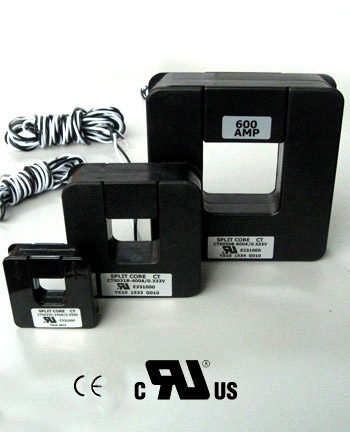
Split Core Current Transformers (S Series)

Applications

  • Electric motors
  • Smart lighting solutions
  • HVAC systems
  • Power management
  • Building automation systems

Features

  • Low cost
  • Split core design for safer and easier installation
Download Datasheet

Specifications

  • Maximum input voltage:
    5000V AC
  • Rated output:
    0.333V AC
  • Ratio error:
    ±1%
  • Phase error:
    less than 2' at 50% of rated input current
  • Operating temperature:
    -15℃ to 50℃.
  • Case material:
    ABS (UL flame retardant rating 94-V0)
  • Frequency:
    50/60Hz
  • Output cable & connector:
    specified by customer
  • UL & CE approved

Product Overview

With a maximum input voltage of 5000V AC and a standardized 0.333V AC output, the S Series Split Core Current Transformers ensure safety and compatibility across diverse power management platforms. The series maintains a strict ratio error of ±1% and a minimal phase error of less than 2′ at 50% rated current. Encased in UL 94-V0 rated flame-retardant ABS, these transformers operate reliably between -15°C and 50°C. Ideal for HVAC, smart lighting, and building automation, they meet UL and CE standards, providing manufacturers with a durable, high-accuracy solution for complex electronic systems and motor protection.

Typical Products

Image Part Number Rated Input (A) Turn Ratio Frequency (Hz) Secondary Burden (Ω) Accuracy Class Dimensions (mm) PDF
Image TA1111 5~30 1000:1
2000:1
2500:1
50 to 400 ≤200 0.1
0.2
0.5
ID-L-W-H 7.0-22.0-18.0-23.0
Image TA1311 5~80 1000:1
2000:1
2500:1
50 to 400 ≤800 0.1
0.2
0.5
ID-L-W-H 7.0-22.0-18.0-23.0
Image Part Number Rated Input (A) Turn Ratio Frequency (Hz) Secondary Burden (Ω) Accuracy Class Dimensions (mm) PDF
Image2 CTT0150 5-150 1:1000
1:2000
1:3000
1:5000
50 to 400 50-400 0.1
0.2
15-58-23-45

    Let’s Build Reliable Engineering Together

    By clicking "Request a Quote", you agree to our Privacy Policy.

    Thank you!

    Your request has been successfully submitted.

    Frequently Asked Questions

    Honeywell needed a stable and highly accurate way to measure current fluctuations in large commercial buildings. Existing sensors often produced noise and drifted over time, creating errors in smart energy dashboards

    Honeywell needed a stable and highly accurate way to measure current fluctuations in large commercial buildings. Existing sensors often produced noise and drifted over time, creating errors in smart energy dashboards

    Honeywell needed a stable and highly accurate way to measure current fluctuations in large commercial buildings. Existing sensors often produced noise and drifted over time, creating errors in smart energy dashboards

    Honeywell needed a stable and highly accurate way to measure current fluctuations in large commercial buildings. Existing sensors often produced noise and drifted over time, creating errors in smart energy dashboards

    Honeywell needed a stable and highly accurate way to measure current fluctuations in large commercial buildings. Existing sensors often produced noise and drifted over time, creating errors in smart energy dashboards